All peptides
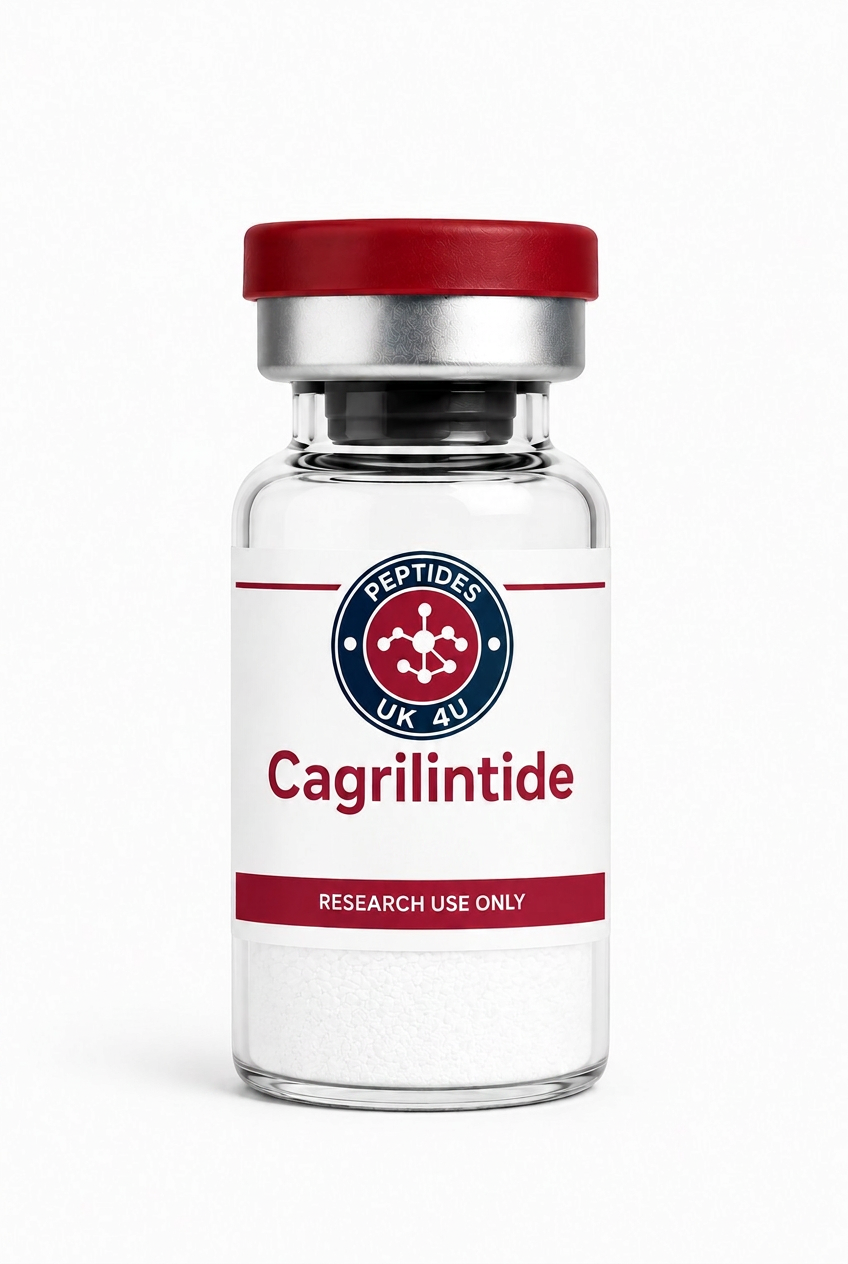
Cagrilintide 10mg
Metabolic

Cagrilintide 10mg

£99.00
SKU: CAG10mg

For In Vitro Use Only — Not for Human Use

Long-acting amylin analogue (10mg vial, ≥98% purity) supplied as a lyophilised powder for in vitro receptor-binding and metabolic-signalling research.

Peptide Type
Long-acting amylin receptor analogue
Molecular formula
C₁₈₇H₂₈₅N₅₅O₅₉S₂
Molecular weight
≈4,289 Da
Form
Lyophilised powder
Quantity
10mg per vial
Purity
≥98% by RP-HPLC
Solubility
Water / bacteriostatic water
CAS
1415456-99-3

Product Overview

Cagrilintide is a long-acting synthetic analogue of the pancreatic hormone amylin, engineered with a fatty-acid side chain that extends its plasma half-life relative to native amylin. Supplied in a 10mg lyophilised vial, it is prepared to ≥98% purity by RP-HPLC for laboratory use only.

Research Overview

Cagrilintide is studied in vitro for its affinity across the amylin receptor family (AMY1R, AMY2R, AMY3R) and its calcitonin-receptor cross-reactivity. Research groups frequently pair Cagrilintide with GLP-1 analogues such as Semaglutide to model complementary metabolic pathways under controlled conditions.
Handling & Use

Reconstitute with bacteriostatic water in a sterile environment. Cagrilintide is typically paired with GLP-1 analogues in dual-agonist research protocols — keep both peptides at matched concentrations for reproducible in vitro comparisons.

Storage Guidelines

  • Lyophilised vials: store below -18°C, protected from light.
  • Reconstituted solution: refrigerate at 2–8°C and use within 28 days.
  • Avoid repeated freeze-thaw cycles to preserve peptide integrity.
Important Notice
  • Strictly for laboratory research use only.
  • Not for human or veterinary use.
  • Not intended to diagnose, treat, cure, or prevent any condition.

Frequently asked questions

What is Cagrilintide used for in research?+

Cagrilintide is used in vitro to study long-acting amylin-receptor signalling and, alongside GLP-1 analogues, as a reference compound in dual-pathway metabolic research.

What purity is your Cagrilintide?+

Every batch is tested to ≥98% purity by RP-HPLC. A batch-specific Certificate of Analysis is available on the COA page and on request.

How is Cagrilintide reconstituted?+

Reconstitute the lyophilised 10mg vial with bacteriostatic water in a sterile laboratory environment. For target concentrations and volumes, use our peptide calculator.

What is the reported half-life of Cagrilintide?+

Published pharmacokinetic literature reports a half-life of approximately 7 days for cagrilintide, which is why research protocols typically use once-weekly administration.

Can Cagrilintide be mixed with other peptides in a single vial?+

We don't recommend mixing peptides in a single vial — it compromises stability characterisation and makes independent purity verification impossible. Prepare and store each peptide separately.

How should reconstituted Cagrilintide be stored?+

Store the reconstituted solution at 2–8°C and use within 28 days. Lyophilised vials are stable below -18°C for extended periods. Avoid repeated freeze-thaw cycles.

Do you ship Cagrilintide from the UK?+

Yes — all Cagrilintide vials are stocked and dispatched from the UK with next-working-day delivery on orders placed before 2pm.

Is Cagrilintide the same as Semaglutide?+

No. Semaglutide is a GLP-1 receptor analogue; Cagrilintide is a long-acting amylin analogue acting on a completely different receptor family (AMY1R/AMY2R/AMY3R). The two are structurally and mechanistically distinct.

View basket0Checkout