All peptides
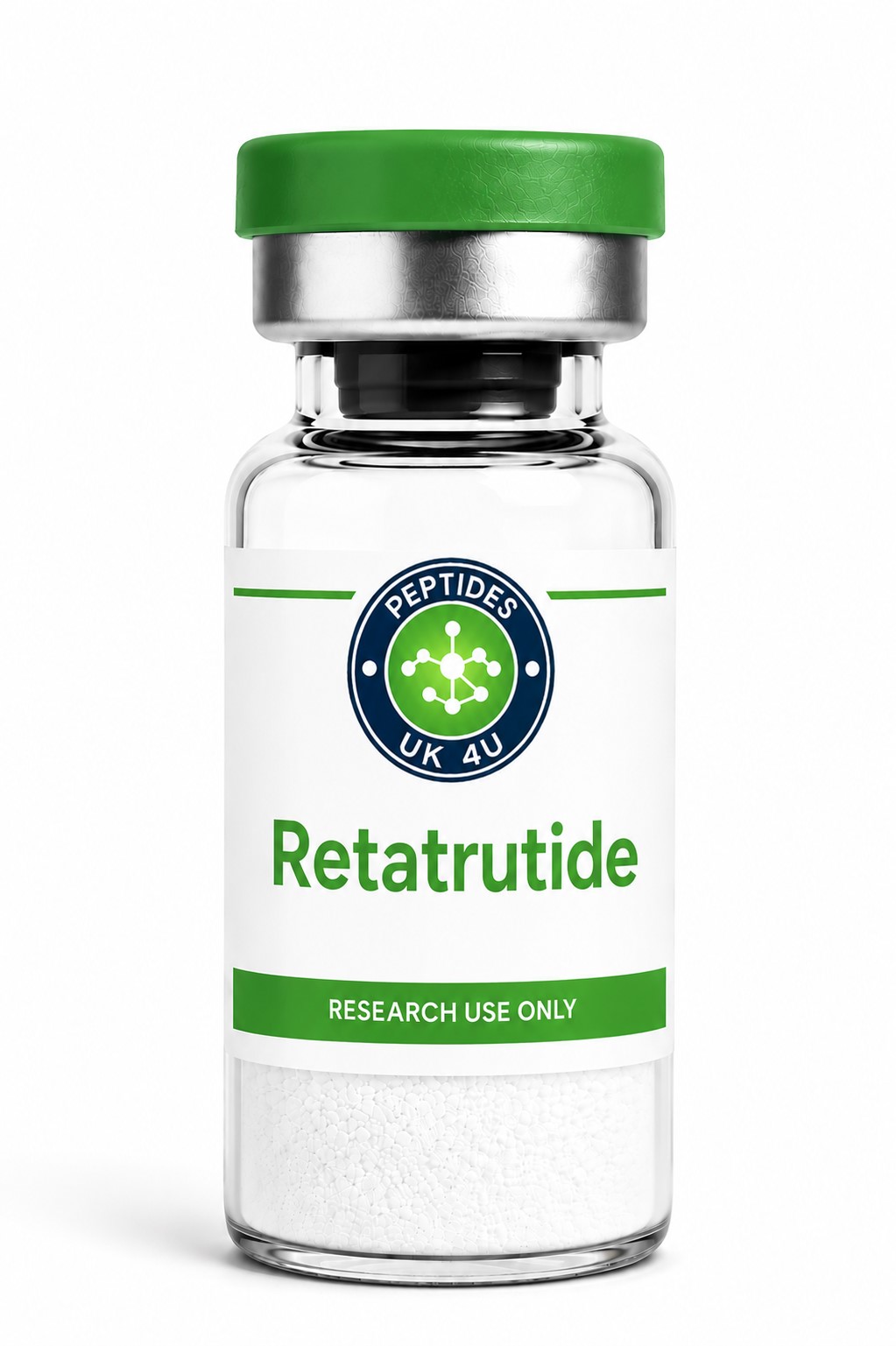
Retatrutide 20mg / 30mg / 40mg
Metabolic

Retatrutide 20mg / 30mg / 40mg

£89.00 – £154.00

For In Vitro Use Only — Not for Human Use

Investigational triple agonist targeting GLP-1, GIP and glucagon receptors — 20mg, 30mg and 40mg lyophilised vials at ≥98% purity for in vitro research.

Size
View COA
Peptide Type
Triple receptor agonist (GLP-1 / GIP / Glucagon)
Sequence length
39 amino acids
Molecular weight
≈4,731 Da
Form
Lyophilised powder
Quantity
20mg, 30mg or 40mg per vial
Purity
≥98% by RP-HPLC + MS
Solubility
Water / bacteriostatic water
Research code
LY-3437943

Product Overview

Retatrutide (LY-3437943) is an investigational triple-receptor agonist that combines activity at the GLP-1, GIP and glucagon receptors in a single 39-residue peptide backbone. Supplied as a sterile lyophilised powder in 20mg, 30mg and 40mg vials, each batch is verified to ≥98% purity by RP-HPLC and mass spectrometry.

Research Overview

Retatrutide is used in vitro to study the combined pharmacology of incretin (GLP-1, GIP) and glucagon receptor signalling in a single molecule. Research groups compare it head-to-head against dual agonists (e.g. Tirzepatide) to characterise receptor bias, cAMP response, and peptide stability across long incubation windows.
Handling & Use

Reconstitute with bacteriostatic water in a sterile environment; the fatty-acid modification gives Retatrutide a long in-solution stability profile relative to native GLP-1. Prepare working aliquots to minimise freeze-thaw cycles.

Storage Guidelines

  • Lyophilised vials: store below -18°C, protected from light.
  • Reconstituted solution: refrigerate at 2–8°C and use within 30 days.
  • Avoid repeated freeze-thaw cycles to preserve peptide integrity.
Important Notice
  • Strictly for laboratory research use only.
  • Not for human or veterinary use.
  • Not intended to diagnose, treat, cure, or prevent any condition.

Frequently asked questions

How does Retatrutide differ from Tirzepatide in research?+

Retatrutide activates three receptors (GLP-1, GIP and glucagon), whereas Tirzepatide is a dual GLP-1 / GIP agonist. The added glucagon-receptor activity is the main mechanistic axis researchers compare in vitro.

What is the reported half-life of Retatrutide?+

Published Phase 1/2 pharmacokinetic data reports a half-life of approximately 6 days, which is why research protocols use once-weekly administration.

What purity is your Retatrutide?+

Every vial is tested to ≥98% purity by RP-HPLC and confirmed by mass spectrometry (~4,731 Da). A batch-specific Certificate of Analysis is published on our COA page.

Which vial size should I choose — 20mg, 30mg or 40mg?+

All three contain the same peptide at the same purity — the choice depends on how much working solution your protocol needs and cost per mg. The 40mg vial has the lowest cost per mg.

How is Retatrutide reconstituted?+

Reconstitute with bacteriostatic water in a sterile laboratory environment. For target concentrations and volumes across the 20/30/40mg vials, use our peptide calculator.

How stable is reconstituted Retatrutide?+

The fatty-acid side chain gives Retatrutide good in-solution stability. Kept refrigerated at 2–8°C and protected from light, working solutions remain suitable for research use for up to ~30 days. Avoid repeated freeze-thaw cycles.

Do you ship Retatrutide from the UK?+

Yes — all Retatrutide vials are UK-stocked with next-working-day dispatch on orders placed before 2pm.

Do you supply a Certificate of Analysis?+

Yes — every batch has a third-party HPLC + MS COA linked from the product page.

View basket0Checkout