Tirzepatide Dual GIP/GLP-1 Mechanism & Purity Standards (2026)
How tirzepatide's dual GIP/GLP-1 agonism works, plus reconstitution, storage, HPLC/MS purity standards and choosing between vial and Quick Pen formats.
For laboratory research and in vitro use only. Not for human or veterinary use. Not MHRA approved.
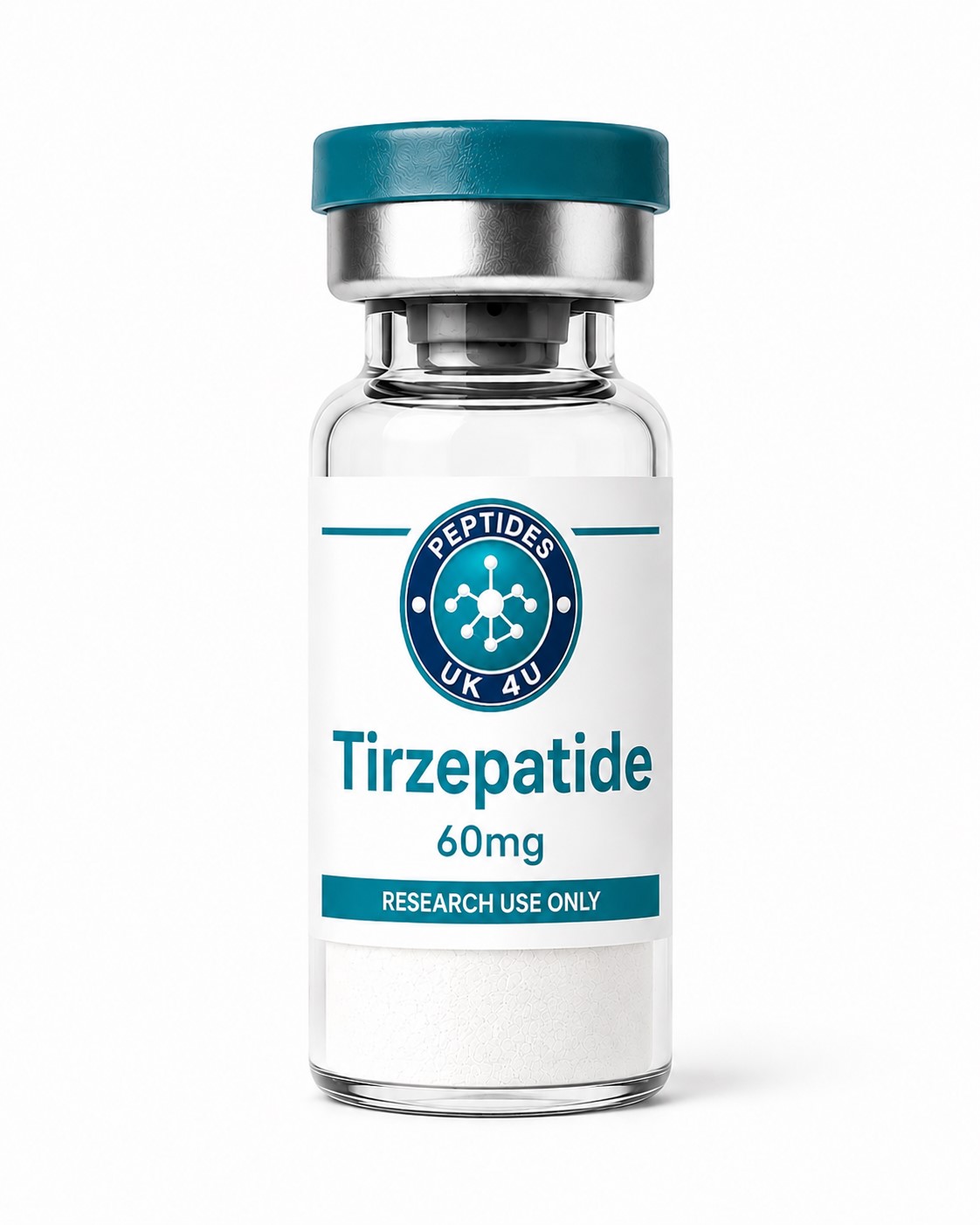
Tirzepatide is a synthetic dual-agonist research peptide engineered to engage both the GIP and GLP-1 receptors from a single molecule. For UK laboratories building multi-receptor incretin studies, that dual-pathway signature is why Tirz has become the reference compound of the modern GLP-1 era — and why sourcing 99%+ HPLC-verified vials from a UK-stocked supplier matters for reproducibility.
This guide covers the molecular profile, the mechanism behind the "twincretin" label, standardised reconstitution and storage protocols, and how to choose between traditional vials and pre-filled Quick Pens.
1. Molecular profile of Tirzepatide
Tirzepatide is a 39-amino-acid synthetic linear polypeptide (~4,813 Da). A C20 fatty diacid moiety linked to the lysine residue at position 20 enables albumin binding, extending the peptide's research half-life to roughly five days in published preclinical data. Without this acylation, the molecule would be rapidly degraded by DPP-4 in study models.
Key engineering choices in the sequence:
- GIP-biased backbone — the scaffold is primarily based on native GIP, with a modified GLP-1 signalling arm.
- Non-coded residues — inclusion of aminoisobutyric acid protects against enzymatic cleavage.
- Potency calibration — receptor affinity is deliberately weighted toward GIP relative to GLP-1.
For a broader UK research overview of vial formats and purity data, see the Tirzepatide UK hub.
2. Dual-receptor mechanism (GIP + GLP-1)
Where Semaglutide engages a single receptor, Tirzepatide activates two simultaneously. The dual-agonist profile is what makes it distinct from earlier GLP-1-only research peptides.
GLP-1 pathway
GLP-1 receptor activation triggers intracellular cAMP signalling and glucose-dependent insulin release from pancreatic beta cells in study models. Downstream observations reported in the literature include delayed gastric emptying and modulation of appetite-related neural pathways.
GIP pathway — the differentiator
GIP receptors are expressed in the pancreas and in white adipose tissue, where the pathway is associated with lipid metabolism and thermogenesis endpoints in preclinical models. The GIP arm is the mechanistic differentiator vs single-agonist research compounds. For a side-by-side comparison, see Tirzepatide vs Semaglutide and Retatrutide vs Tirzepatide, or browse the full Buy Retatrutide UK hub for triple-agonist stock.
3. Reconstitution — laboratory protocol
Reconstitute with bacteriostatic water (BAC water) so the vial can be used across a multi-draw research protocol. Sterile water is only appropriate for single-use assays completed within 24 hours.
We recommend using up to 3 mL of bacteriostatic water per vial — this keeps the solution concentrated, minimises total injection volume, and still dissolves the lyophilised cake cleanly. Typical UK-stocked vial fills:
- 20mg + 2 mL BAC → 10 mg/mL.
- 40mg + 3 mL BAC → ~13.3 mg/mL.
- 60mg + 3 mL BAC → 20 mg/mL.
Do not exceed 3 mL of BAC water in a single vial. Confirm exact volumes for your target concentration in the peptide reconstitution calculator. Full step-by-step handling is in the peptide reconstitution guide.
Handling rules
- Swab the stopper with 70% isopropyl alcohol before piercing.
- Angle the needle so BAC water runs down the vial wall — don't strike the lyophilised cake directly.
- Swirl gently, never shake. Agitation can shear the peptide chain.
4. Storage & stability
- Lyophilised (unopened): stable at 2–8°C for extended periods; long-term stocks preserved at −20°C.
- Reconstituted with BAC water: refrigerate at 2–8°C, protect from light, and use within roughly 4 weeks.
- Avoid repeated freeze-thaw cycles; use opaque containers or keep vials in their original box.
5. Purity — what a proper COA shows
Every batch of Tirzepatide we supply is independently HPLC tested at 99%+ purity. A credible Certificate of Analysis includes:
- HPLC chromatogram — main-peak area confirms percent purity by retention time.
- Mass spectrometry (LC-MS or MALDI-TOF) — confirms molecular mass matches ~4,813 Da for the correct 39-residue chain.
- Batch number and date of analysis, signed by an independent lab.
View published batch COAs on our COA page. If a supplier can't produce a batch-specific report, treat that as a red flag.
6. Vials vs pre-filled Quick Pens
Standard vials give the widest concentration flexibility — ideal when your protocol needs bespoke reconstitution volumes. Pre-filled Tirzepatide Quick Pens ship factory-reconstituted from the same lab-tested batches, remove volume variance between researchers, and cut consumables per mg. Both are UK-stocked and cold-shipped next day.
7. UK sourcing & logistics
UK-domestic dispatch keeps lyophilised vials in cold transit for the shortest possible window. Every order ships from our UK facility in insulated packaging via Royal Mail 24-tracked, in plain unbranded outer packaging. Order before 1pm Mon–Fri for same-day dispatch. Browse the full Tirzepatide product page or the buy Tirzepatide UK guide for available strengths.
All content above is for laboratory research and in vitro use only. Not for human or veterinary use. Not MHRA approved. Peptides UK 4U supplies research-grade peptides to laboratory customers only.
Frequently Asked Questions
What is the recommended reconstitution ratio for a Tirzepatide vial?+
Use up to 3 mL of bacteriostatic water per vial. A 20mg vial reconstitutes at 10 mg/mL in 2 mL; 40mg and 60mg vials use 3 mL for ~13.3 mg/mL and 20 mg/mL respectively. Confirm your target concentration and syringe unit count in the on-site peptide reconstitution calculator before dosing.
How long is reconstituted Tirzepatide stable in a laboratory fridge?+
Once reconstituted with bacteriostatic water and refrigerated at 2–8°C, protected from light, published peptide-stability data supports use within approximately 4 weeks. Avoid freeze-thaw cycles.
How should lyophilised Tirzepatide be stored before reconstitution?+
Store unopened lyophilised vials at 2–8°C for short-term stocks, or −20°C for long-term preservation. Both prevent moisture absorption and enzymatic degradation of the peptide cake.
Why is bacteriostatic water preferred over sterile water for Tirzepatide research?+
Bacteriostatic water contains 0.9% benzyl alcohol as a preservative, allowing multiple sterile draws from the same vial over a research protocol. Sterile water is single-use only.
How does Tirzepatide compare to Retatrutide in dual vs triple-agonist studies?+
Tirzepatide is a dual GIP/GLP-1 agonist. Retatrutide adds a third pathway — glucagon receptor activation. Both are supplied by Peptides UK 4U at 99%+ HPLC purity; see the Retatrutide vs Tirzepatide comparison page for a full side-by-side.
Is a peptide calculator necessary for Tirzepatide reconstitution?+
Yes — a calculator removes the risk of manual arithmetic error when converting between vial mass, diluent volume, target concentration and syringe unit count. Use the on-site peptide reconstitution calculator to lock in your protocol before drawing a dose.
Related articles
- Tirzepatide Pen Clicks Per mg — 20mg, 40mg & 60mg Guide
A UK step-by-step walkthrough for pre-filled tirzepatide Quick Pens: clicks-per-mg by strength, priming, dose selection, injection technique, storage and how many doses you get per pen.
- Semaglutide Pen Clicks Per mg — 10mg, 20mg & 30mg Guide
A UK step-by-step walkthrough for pre-filled semaglutide Quick Pens: units and clicks per mg, priming, dose selection, injection technique, storage and doses per pen.
- Bacteriostatic Water: A UK Guide to Peptide Reconstitution (2026)
Why bacteriostatic water is the correct multi-draw diluent for peptide reconstitution: the role of 0.9% benzyl alcohol, BAC vs sterile water, the 28-day rule and a slow-drip handling protocol for UK laboratories.
For In Vitro Use Only — Not for Human Use. Content is for laboratory research and educational purposes only.